Thank you for taking the time to review the work I have done in connection with Context and Narrative, all of which is available online via this blog.
The blog is laid out in reverse order of date, with the newest postings appearing first. Unfortunately, this means that when I have reworked assignments the updated work appears much later in the blog than the rest of the items associated with that portion of the course. The easier way to navigate the blog, then, is often by using the tags that categorise each post.
As required, I have also uploaded selections of my work that illustrate each of the Learning Outcomes (LOs) to the G: drive. My ‘reflective presentation’ and Tutor Reports have also been uploaded to the appropriate directories in the G: drive.
LO1—create images that demonstrate a practical and conceptual understanding of techniques, and the importance of context in creating meaning and narrative.
LO3—conduct research, development and production of photographic work in response to the themes explored in this unit and show a developing understanding of contemporary imagery in relation to historical practice and theory.
LO4—show an ability to critique your own imagery and reflect upon your learning experience, and developing sophistication of your assessment of the work of other practitioners.
Does their presence on a gallery wall give these images an elevated status?
Yes, certainly. An artist has selected the images, built a show around them, displayed them in a gallery and invited others to view them—this imbues the photographs with significance. The fact that people were willing to attend the show and buy the works demonstrates that what once had little or no value, has now gained in value.
Where does their meaning derive from?
The meaning of the photographs derives from a number of sources, but the gallery presentation may be the most important. The new context for the images changes the way that they will be viewed: they will be seen as a collection (although they did not originally belong together); they will have status because someone else has granted it (artist, gallery, media reports, other viewers); and they will be seen as art rather than simple, personal photographs (the mere act of hanging on a wall will go a long way to attracting the ‘art’ label).
When they are sold (again on eBay, via auction direct from the gallery) is their value increased by the fact that they’re now ‘art’?
I would expect that the photographs will gain appreciably in value (both artistic and monetary). They may have sold for a pound or two before—or not at all—but their new notoriety and ‘art’ status gives them a cachet that will raise their prices.
I would also expect that the competitive nature of human beings in an auction will further increase the selling price of the photographs. Few people knew or cared about them when they were first offered up on eBay, but the potential market has increased in size and no one likes to feel that they have lost an opportunity to a rival bidder. The aggressive behaviour of bidders I have witnessed in eBay auctions often inflates the cost of buying even ordinary items. And these are no longer ordinary items.
Professor Adjunct in Graduate Photography at Yale School of Art.
Represented by Gagosian Gallery in New York and White Cube in London.
Elaborately staged scenes in small town American. Cinematic, extensive support crew for staging and lighting.
“In all my pictures what I am ultimately interested in is that moment of transcendence or transportation, where one is transported into another place, into a perfect, still world. Despite my compulsion to create this still world, it always meets up against the impossibility of doing so. So, I like the collision between this need for order and perfection and how it collides with a sense of the impossible. I like where possibility and impossibly meet.” (Gregory Crewdson (2016))
Influences include movies Vertigo, The Night of the Hunter, Close Encounters of the Third Kind, Blue Velvet, and Safe, also Edward Hopper, Diane Arbus.
Retrospective of work from 1985–2005 shown in Europe from 2005–08. Skowhegan Medal for Photography, the National Endowment for the Arts Visual Artists Fellowship and the Aaron Siskind Fellowship.
Responses
There is certainly more to Crewdson’s work than aesthetic beauty, although it undeniably has that. The coldness of the images and the unsettling scenes they portray have an uncanniness to them—they seem more real than real. The attention to detail, flawless lighting and calculated impact on the viewer reveal suggest that the artist is not simply drawing on aesthetic categories, but using the everyday to produce a particular effect or experience.
The work certainly seems ‘psychological’ to me, in that it is designed to produce an unease and questioning in the mind of the viewer. There is a distinct sense of foreboding, the same kind one feels when watching a thriller—what ‘it’ is has not yet happened, but it is about to and the psychological tension is palpable. It verges on the physical, as if the viewer was about to experience the events directly. If anything, many of these images are like Nordic Noirs in a single frame.
My main goal when making pictures has not at all been to create an elaborate world of my imagination, but to respond to things that I find visually appealing (in a broad sense: light, line, colour, form, mood…). My studies with the OCA have been leading me to question this approach, however, as I see the opportunity to make images in an entirely new way—more deliberate and purposeful, rather than just responsive. I don’t think that there is anything wrong with making beauty one’s main goal—we could certainly use more beauty in the world—but I think that aesthetics for the sake of aesthetics can become divorced from other important commitments like truth or justice. Beauty itself can be fickle and concentration on it can lead us down some very strange paths, like self-indulgence, an unhealthy preoccupation with certain kinds of beauty or deliberately ignoring the non-beautiful.
I don’t think it is necessary to set “elaborate direction”against “subtlety and nuance” in photography, any more than it is necessary to set pure fantasy against documentary or biography in any other art form, such as cinema. There is a place to appreciate all of them and the different responses they call forth, while keeping in mind that they are all, to some extent, fabrications.
MA art history from UBC, 1970. Postgraduate research at the Courtauld Institute in London from 1970–73.
Draws on elements from other art forms—including painting, cinema, and literature—in an approach he calls “cinematography.” Large scale constructions and montages. Conceptualism.
Frequently displays work as backlit color transparencies, similar to street advertising, but has more recently worked with b/w printing and inkjet colour.
Early work sometimes evoked other artworks: “The Destroyed Room (1978) explores themes of violence and eroticism inspired by Eugène Delacroix’s monumental painting The Death of Sardanapalus (1827), while Picture for Women (1979) recalls Édouard Manet’s A Bar at the Folies-Bergère (1882) and brings the implications of that famous painting into the context of the cultural politics of the late 1970s.”
“Near documentary” work made in collaboration with non-professional models who appear in them.
Studied photography and film at Napier University, Edinburgh (1992–1995) and photography at the Royal College of Art, London (1996–1997). Lives and works in London.
Works predominantly with women as subjects, actresses as well as people she meets on-site to develop scenes. Stark architecture and strong colour.
Says of her photographs that they are “explorations of everyday experiences and observations of inner city life from a female perspective.”
Works are frequently untitled and show freeze-framed crisis points: issues of class, race, gender, and identity. Intimate moments.
Works in photography and film. Photographs often reference and reimagine classical paintings. First photographer to have a one-man show at the National Gallery, London.
Socially- and politically-motivated work.
“Painters inspire me most – Caravaggio, Vermeer – but I also like Dorothea Lange and Sally Mann.”
Series “Persons Unknown”: portraits of squatters in the abandoned Hackney warehouses. Won the Photographic Portrait Award at the National Portrait Gallery in 1998 for an image of a young woman with a baby beside her, reading a possession order, shot like a Vermeer painting.
Multidisciplinary artist in photography, text, sculpture, and performance. Work featured in the Venice Biennale (2015). Guggenheim Fellow, 2001.
Studied environmental sciences at Brown University but transferred to a degree in art-semiotics, while taking photography classes at Rhode Island School of Design. BA 1997. Visiting artist at Yale, Bard, Columbia, School of Visual Arts, and Parsons School of Design.
The Innocents (2003) — stories of individuals wrongly sentenced to death or life, then released and gained exoneration due to DNA evidence. Mistaken identity, questionable reliability of evidence.
An American Index of the Hidden and Unfamiliar (2007) — objects, sites, and spaces integral to America but not accessible to public (radioactive capsules at a nuclear waste storage facility; black bear hibernating; CIA art collection).
Heavy research and preparation for each project: “The majority of my work is about preparation. The act of taking photographs is actually a very small part of the process. I work with a small team, just my sister and one assistant.”
Studied at the School of the Museum of Fine Arts, Boston. Then attended Yale, MFA Photography, 1979. Lives and works in NYC and teaches at Yale.
Mixes snapshots and staged compositions that are theatrical in nature. Carefully planned staging, documentary, cinema and advertising. Line between reality and artifice/fantasy blurred.
Accidental poses, unintended movements, insignificant facial expressions. Series, Hustlers, Streetwork, Heads, A Storybook Life, and Lucky Thirteen, conceptual in nature.
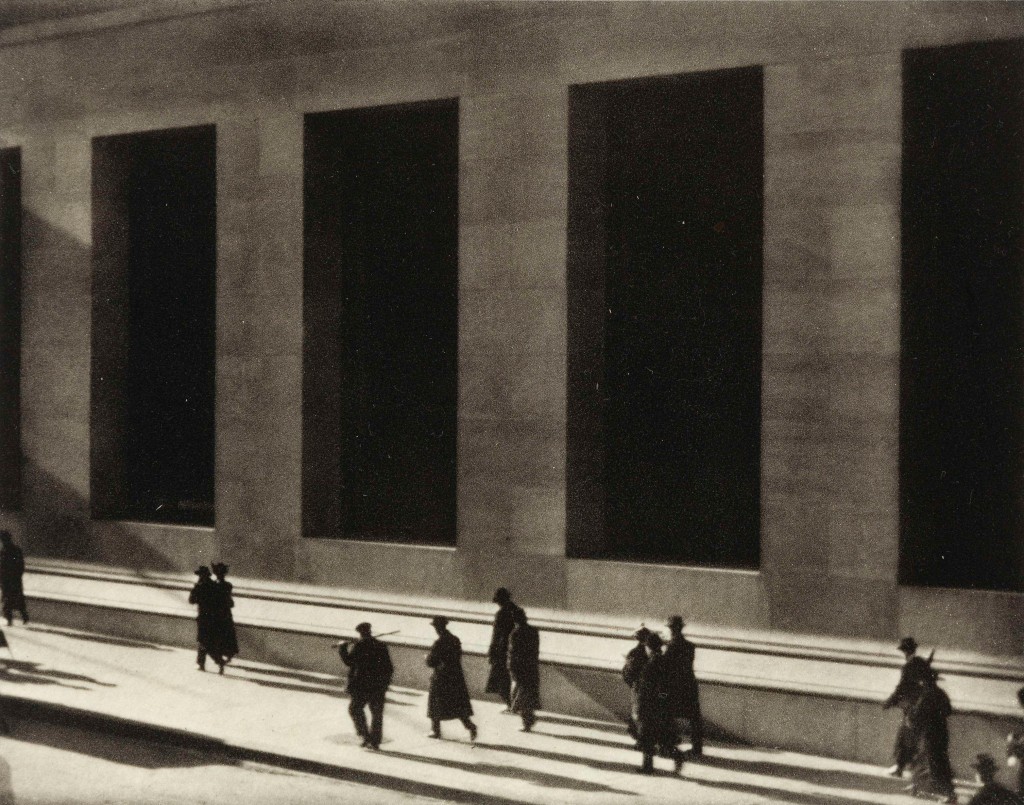
“Paul Strand’s 1915 photograph of Wall Street workers passing in front of the monolithic Morgan Trust Company can be seen as the quintessential representation of the uneasy relationship between early twentieth-century Americans and their new cities.” (Philadelphia Museum of Art, 1995:230).
Wall Street, 1915 is indeed a picture full of tension, simultaneously celebrating the accomplishments of the modern world while fearing what they might imply.
The photograph was one of six Strand images published by Alfred Stieglitz in Camera Work (Strand and Barberie, 2014:14) that launched his career as an artist and marked a departure from his earliest work in the Pictorialist style (Jeffrey, 2008:114). Leaving behind “his faltering attempts at fogbound, neo-romantic landscapes in the nineteen-tens” (Dickson, 2016), Strand embraced Modernism in scenes from urban life and experiments with abstraction, perhaps influenced by Cubism (Koetzle, H.-M., 2002:170). The influence of the picture was significant and it has been credited with doing “much to lead American photography toward sharp-focus realism as well as abstraction, toward urban subjects and the machine aesthetic” (Milton W. Brown, cited in Wall Street, New York, 1915, s.d.).
More than a century later Wall Street, 1915 can easily be recognised as portraying a daily commute, with people walking to or from their place of work while the sun is low in the early morning sky. It depicts an urban scene, with background architecture that is both modern and clearly American rather than European. The building that serves as a backdrop for the commuters appears very institutional and suggests the intimidating power of a bank, major corporation, or government.
The frame is heavy with geometry and leading lines—a deceptively simple image containing little or no detail in the shadows. The print is somewhat muddy, with deep shades of black but no true whites. This may have been a conscious choice on the part of the photographer, given that the highly-directional side lighting should have been capable of producing both deep shadows and brilliant highlights.
The figures in the scene are all walking in the same direction and there is a palpable sense of deliberate slowness. One man—few of the walkers appear to be female—has shouldered a cane or walking stick at an angle contrary to all the others in the frame, a lone working-class punctum whose presence among the better-dressed walkers might prick the attention of the careful viewer (see Barthes, 2010:27). The commuters are pacing themselves, perhaps in no particular rush to begin the work day.
If the commuters are in no hurry, the solid stone mass of the building behind them appears positively immovable. Where there should be windows, deep, shadowed rectangles suggest unseeing eyes or open graves—Strand himself later spoke of its “sinister windows—blind shapes” (Jeffrey, 2008:115). The imposing geometry of the structure dominates the street scene, its scale a display of power that dwarfs the organic shapes moving in front of it.
Oblivious to the dark heaviness beside and above them, the people walk casually into a rising sun with its early light full in their faces. The dawn connotes the promise of a new day and perhaps carries with it additional promises of knowledge and hope for the future. The glare in their eyes might not allow them a view of where they are going, but they may follow the orderly lines laid out for them on the pavement. The walkers can probably not see each other very well and, even though some travel in small clusters, this is largely a collection of individuals. They move in a common direction but they are not together.
The people are the only non-geometric, organic shapes, but they too are given a kind of geometry by their own shadows that distinguish them from the vertical lines of the monolith behind, long arms pointing backward and slowing their progress.
Wall Street, 1915 has all the dramatic feel of a movie set, looking much like a production still from a silent film backlot. The same idea may have occurred to Strand himself because, although he later claimed that he did not know how he had made the picture (Strand and Barberie, 2014:14), he returned to the location and reproduced a close facsimile of the scene in the 1921 film Manhatta (1921). Just a few years later director Fritz Lang’s Metropolis (1927) would offer a full-blown dystopian story of the evils of modern, mechanized city life, with great attention to the scale of buildings versus human figures—humans dominated by their own creations. Lang admitted that “the film was born from my first sight of the skyscrapers in New York in October 1924. […] I looked into the streets—the glaring lights and the tall buildings—and there I conceived Metropolis” (Minden and Bachmann, cited in Metropolis (1927 film) 2020).
But Wall Street, 1915 is not quite a dystopia. It is something more complex, managing to show “Strand’s willingness to accommodate documentary realism and abstraction within the same frame” (Paul Strand Artworks & Famous Photography, s.d.) and it is this tension that continues to give the photograph its power. The picture portrays an everyday scene of commuters heading to their place of work in an orderly, unhurried way leaving little trace of motion blur on the photographic plate. The walkers wear clothing that might be suitable for a cool spring or fall day, but they will enjoy a few moments to soak in whatever warmth may be had from the strong morning light.
If the reality conveyed by the image is common and reassuring, however, the abstraction is less so. The scene is crossed with graphic, sharp diagonals and inky rectangular pits that stay in the mind’s eye after the viewer has turned away—the kind of scene that Barthes might call subversive, “not when it frightens, repels, or even stigmatizes, but when it is pensive, when it thinks” (Barthes, 2010: 38). The daily commute is played out against a menacing backdrop that hints physically and visually at the power the rising city and its economy have over the workers. It would not be too many more years before the same dark windows were witness to the explosion of an anarchist bomb (1920) and the stock market crash (1929) that would ruin so many hopes.
Strand’s workers stroll forever, enjoying the benefits of living in the great city. If they are aware of any tension, their pace does not show it. But the signs are there.
References
Barthes, R. (2010) Camera Lucida: reflections on photography. (Paperback ed.) New York: Hill and Wang.
Erwitt’s dog picture has been cropped in such a way that the viewer is placed at eye-level with a chihuahua. If this image is not a crop, then the photographer must have placed his camera on or near the ground. The startling thing about the photograph is the gradual realisation that the leftmost pair of legs belong not to a human, but to another dog. This now means that the head of the larger dog is actually above the photographer’s line of sight, not at all the regular point of view.
I don’t know that the image is necessarily ‘saying’ anything, beyond being a visual joke, but it might suggest something important about relative position or status: you may be bigger than some, but you might still be someone else’s ‘small dog’ in life.
BA in Economics, University of Tartu; BA in Photography at The University for the Creative Arts; MA in Photography at The University of Westminster.
Fellow of HEA, teaches at UCA (Farnham)
Cultural identity and gender issues within historical and contemporary contexts.
Works with stories and histories from collection of vernacular photography. Also works with video, installation and object-based art.
Nigel Shafran
UK, 1964– .
Photographer and artist. Work exhibited at Tate and the Victoria and Albert Museum. Worked as a fashion photographer in 1980s before turning to fine art.
Publications include Ruthbook (1995), Dad’s Office (1999), Edited Photographs 1992-2004 (2004), Flower’s for ___ (2008), Ruth on the phone (2012), Teenage Precinct Shoppers (2013), Visitor Figures (2015), Dark Rooms (2016), and The people on the street (2018).
” In photographing everyday elements and details, Shafran captures something of the fabric of our lives, the background noise that usually goes unnoticed, but which shapes us and our fate” (Everyday beauty, 2018).
Response
Yes, it did surprise me when I saw the image from Washing Up in the course manual that the photographer was a man. There is no reason why a man should not take such a picture, but I think it is fair to say that women photographers have more often taken pictures in the home, especially those connected with domestic tasks or rituals.
I am not entirely sure how to answer whether gender contributes to an image, except that I suppose it must: perhaps not so much in the choice of subject matter or technique, but more in the way that every creation springs from a context (the artist as a gendered creator) and is viewed within another context or narrative (the viewer as a gendered interpreter). I don’t think that this automatically determines the intent or the understanding of a work, but it would be hard to deny the presence or influence of gendered constructs.
The line of questioning in the course manual could serve to underline that viewers of the images may make certain assumptions about the person who created them and the situation within which they were created. Perhaps. What is more interesting to me is how humans are present to us in the things of their lives and in the way they order them. (Is it a clean kitchen? Is it orderly? What kind of food is prepared there? What social standing might be implied by the setting? Are there other clues as to the people who live here?) The setting is the stage of domestic life and it invites speculation about the actors who set the scene and perform there.
So yes, these are interesting still life compositions. I am naturally curious about other people and how they live. What are they telling me? How are they like me? How are they different from me?
I have chosen to recreate a memory of something that happened to me when I would have been about eight years old. I was with some neighbourhood friends and we were rolling down the sides of the drainage ditch that ran behind our houses. It was late fall, so the ditch was dry and full of grasses and weeds.
I decided to go everyone one better and rolled backwards instead of forwards, only to find myself stuck at the bottom with my feet in the air and the zipper of my jacket stuck to the skin of my throat. Any movement pulled on the zip fastener and cause it to bite deeper into my skin. So I lay there until one of my friends was able to get my dad to come and help me out.
Help is coming
Children get into these sorts of scrapes all the time, but what stayed with me was the sense of how time slowed as I waited and gazed up at the sky through my feet. And the mix of feelings: the zip hurt my neck and I was afraid to move, upside-down and disoriented, a bit panicky but calm and observant all at once. I have since felt that unreal mix at other times of crisis: panic and calm, urgent action and slow motion.
I created this image fairly literally, but these are an adult’s legs and feet, not a child’s. And I believe that the image (and the experience behind it) point to the disorientation we can feel on two levels, both physical and emotional: our world has been turned on its head.
I decided to give the image a title because that has often been my experience—in the midst of disruption, help is coming. It is rare to be completely alone, but the hard part is being patient while waiting.
The photograph does resemble my memory in many physical respects, but the most important part for me is the feelings it summons and the upset perspective one has. I think most viewers, even if they had no sense of the story that gave rise to the image, would recognize that all is not well with the figure who belongs to the legs and feet. If anything, the picture could be seen as a capture of someone who is in the middle of falling, with a blank sky and the hint of a roofline above.



 Context and Narrative