Research—Setting the scene

Jeff Wall (Vancouver, 1946– )

  • MA art history from UBC, 1970. Postgraduate research at the Courtauld Institute in London from 1970–73.
  • Draws on elements from other art forms—including painting, cinema, and literature—in an approach he calls “cinematography.” Large scale constructions and montages. Conceptualism.
  • Frequently displays work as backlit color transparencies, similar to street advertising, but has more recently worked with b/w printing and inkjet colour.
  • Early work sometimes evoked other artworks: “The Destroyed Room (1978) explores themes of violence and eroticism inspired by Eugène Delacroix’s monumental painting The Death of Sardanapalus (1827), while Picture for Women (1979) recalls Édouard Manet’s A Bar at the Folies-Bergère (1882) and brings the implications of that famous painting into the context of the cultural politics of the late 1970s.”
  • “Near documentary” work made in collaboration with non-professional models who appear in them.

Jeff Wall (2018) At: https://gagosian.com/artists/jeff-wall/ (Accessed 26/01/2020).

Jeff Wall (2020) In: Wikipedia. At: https://en.wikipedia.org/w/index.php?title=Jeff_Wall&oldid=934463406 (Accessed 26/01/2020).

Jeff Wall Photography, Bio, Ideas (s.d.) At: https://www.theartstory.org/artist/wall-jeff/ (Accessed 26/01/2020). Tate (s.d.)

Jeff Wall: room guide, room 6. At: https://www.tate.org.uk/whats-on/tate-modern/exhibition/jeff-wall/jeff-wall-room-guide/jeff-wall-room-guide-room-6 (Accessed 26/01/2020).

Lubow, A. (2007) ‘The Luminist’ In: The New York Times 25/02/2007 At: https://www.nytimes.com/2007/02/25/magazine/25Wall.t.html (Accessed 26/01/2020).

Hannah Starkey (Belfast, 1971– )

  • Studied photography and film at Napier University, Edinburgh (1992–1995) and photography at the Royal College of Art, London (1996–1997). Lives and works in London.
  • Works predominantly with women as subjects, actresses as well as people she meets on-site to develop scenes. Stark architecture and strong colour.
  • Says of her photographs that they are “explorations of everyday experiences and observations of inner city life from a female perspective.”
  • Works are frequently untitled and show freeze-framed crisis points: issues of class, race, gender, and identity. Intimate moments.

Hannah Starkey | artnet (s.d.) At: http://www.artnet.com/artists/hannah-starkey/ (Accessed 26/01/2020).

Hannah Starkey – Artists – Tanya Bonakdar Gallery (s.d.) At: http://www.tanyabonakdargallery.com/artists/hannah-starkey/series-photography_4 (Accessed 26/01/2020).

Hannah Starkey – Artist’s Profile – The Saatchi Gallery (s.d.) At: https://www.saatchigallery.com/artists/hannah_starkey.htm (Accessed 26/01/2020).

O’Hagan, S. (2018) ‘The photography of Hannah Starkey – in pictures’ In: The Guardian 08/12/2018 At: https://www.theguardian.com/artanddesign/gallery/2018/dec/08/the-photography-of-hannah-starkey-in-pictures (Accessed 26/01/2020).

Tom Hunter (Bournemouth, 1965– )

  •  Works in photography and film. Photographs often reference and reimagine classical paintings. First photographer to have a one-man show at the National Gallery, London.
  • Socially- and politically-motivated work.
  • “Painters inspire me most – Caravaggio, Vermeer – but I also like Dorothea Lange and Sally Mann.”
  • Series “Persons Unknown”: portraits of squatters in the abandoned Hackney warehouses. Won the Photographic Portrait Award at the National Portrait Gallery in 1998 for an image of a young woman with a baby beside her, reading a possession order, shot like a Vermeer painting. 

Pulver, A. (2009) ‘Photographer Tom Hunter’s best shot’ In: The Guardian 04/11/2009 At: https://www.theguardian.com/artanddesign/2009/nov/04/photography-tom-hunter-best-shot (Accessed 26/01/2020).

Tom Hunter – Artist (s.d.) At: http://www.tomhunter.org/ (Accessed 26/01/2020).

Tom Hunter – 29 Artworks, Bio & Shows on Artsy (s.d.) At: https://www.artsy.net/artist/tom-hunter (Accessed 26/01/2020). Tom Hunter – Artists – Yancey Richardson (s.d.) At: http://www.yanceyrichardson.com/artists/tom-hunter (Accessed 26/01/2020).

Tom Hunter – Artist’s Profile – The Saatchi Gallery (s.d.) At: https://www.saatchigallery.com/artists/tom_hunter.htm (Accessed 26/01/2020).

Unheralded Stories Series | Tom Hunter (s.d.) At: http://www.tomhunter.org/unheralded-stories-series/ (Accessed 26/01/2020).

Taryn Simon (NYC, 1975– )

  • Multidisciplinary artist in photography, text, sculpture, and performance. Work featured in the Venice Biennale (2015). Guggenheim Fellow, 2001.
  • Studied environmental sciences at Brown University but transferred to a degree in art-semiotics, while taking photography classes at Rhode Island School of Design. BA 1997. Visiting artist at Yale, Bard, Columbia, School of Visual Arts, and Parsons School of Design.
  • The Innocents (2003) — stories of individuals wrongly sentenced to death or life, then released and gained exoneration due to DNA evidence. Mistaken identity, questionable reliability of evidence.
  • An American Index of the Hidden and Unfamiliar (2007) — objects, sites, and spaces integral to America but not accessible to public (radioactive capsules at a nuclear waste storage facility; black bear hibernating; CIA art collection).
  • Heavy research and preparation for each project: “The majority of my work is about preparation. The act of taking photographs is actually a very small part of the process. I work with a small team, just my sister and one assistant.”

O’Hagan, S. (2011) ‘Taryn Simon: the woman in the picture’ In: The Observer 21/05/2011 At: https://www.theguardian.com/artanddesign/2011/may/22/taryn-simon-tate-modern-interview (Accessed 26/01/2020).

Taryn Simon (s.d.) At: http://www.tarynsimon.com/ (Accessed 26/01/2020a).

Taryn Simon (s.d.) At: https://www.guggenheim.org/artwork/artist/taryn-simon (Accessed 26/01/2020b).

Taryn Simon – 107 Artworks, Bio & Shows on Artsy (s.d.) At: https://www.artsy.net/artist/taryn-simon (Accessed 26/01/2020).

Philip-Lorca DiCorcia (Hartford, 1951– )

  • Studied at the School of the Museum of Fine Arts, Boston. Then attended Yale, MFA Photography, 1979. Lives and works in NYC and teaches at Yale.
  • Mixes snapshots and staged compositions that are theatrical in nature. Carefully planned staging, documentary, cinema and advertising. Line between reality and artifice/fantasy blurred.
  • Accidental poses, unintended movements, insignificant facial expressions. Series, HustlersStreetworkHeadsA Storybook Life, and Lucky Thirteen, conceptual in nature.

DiCorcia, P.-L. (2001) Philip-Lorca diCorcia, Heads. Steidl Box Pacemacgill.

Kimmelman, M. (2001) Philip-Lorca diCorcia — ‘Heads’. At: http://www.nytimes.com/2001/09/14/arts/art-in-review-philip-lorca-dicorcia-heads.html

MoMA Learning. At: https://www.moma.org/learn/moma_learning/philip-lorca-dicorcia-head-10-2002

Philip-Lorca diCorcia | MoMA. At: https://www.moma.org/artists/7027

Philip-Lorca diCorcia | artnet (s.d.) At: http://www.artnet.com/artists/philip-lorca-dicorcia/ (Accessed 26/01/2020).

Philip-Lorca diCorcia – 46 Artworks, Bio & Shows on Artsy (s.d.) At: https://www.artsy.net/artist/philip-lorca-dicorcia (Accessed 26/01/2020).
Exercise—Setting the scene

What does this scene tell you about the main character?

  • He has money and influence and is widely known.
  • He is confident of his power and not afraid to show it.
  • Others want his attention and/or good favour.

How does it do this? List the ‘clues’.

  • He has an expensive car.
  • He has money and is willing to pay for extra services.
  • He has access to things that most people would have to wait for (doorman lets him in via a side entrance, ahead of the queue waiting outside a club).
  • He is proud of all this and wants the woman he is with to know it.
  • He is a regular at this club and knows the staff by name.
  • He is comfortable enough to take a walk uninvited and unescorted through the kitchen. No one objects.
  • He expects to get a table directly in front of the Copacabana’s stage and does so, ahead of others who are waiting.
  • The surrounding customers are anxious to greet him.
  • A table full of men send a complimentary bottle of wine to his table and raise their glasses to him in salute.
  • He says he works in construction, but his hands do not feel like those of a labourer.
  • He says he is a union delegate.

Reference

The Long Take: Goodfellas (s.d.) At: https://www.youtube.com/watch?v=OJEEVtqXdK8 (Accessed 25/01/2020).

A4—Reflection

Demonstration of technical and visual skills

  • The category of “visual skills” does not apply in the usual way for this assignment because I did not have to create any imagery. The category does apply, however, in the sense of applying those skills in looking carefully at an image created by someone else. I will give my comments on how successfully I did that in the “Quality of outcome” sub-section.
  • The other technical skills employed for this assignment were connected with my writing ability. I am confident that my writing is clear and cogent, and does not suffer from too many basic faults.

Quality of outcome

  • I am quite pleased with the outcome of the assignment in a number of respects. The first of these is that I gave myself the time to spend just looking at Strand’s image and to explore it fully. Wall Street, 1915 is a picture that has stayed in my mind for many years and I have never really articulated to myself, much less anyone else, why it had such a hold in my imagination. It was a kind of gift for me to be able to give it sustained attention and help to answer my own question: why do I care about this picture?
  • I was not interested in putting together a collection of views and insights lifted from other interpreters, but wanted to do the close work of doing my own interpretive work. I think I have achieved that.

Demonstration of creativity

  • I made an effort to delve into some of the intertextuality that Wall Street, 1915 suggested to me. The first of these was Fritz Lang’s film, Metropolis, so it was exciting to me to find out that Strand himself had returned to the scene of his still image to give it a place in his own film, Manhatta.
  • I also used my imagination in looking at the walkers and thinking about what their postures, attitudes and clothing might suggest. I did the same with the bold lines of the shadows, buildings and sidewalks.
  • Can I be sure that my views and interpretations are accurate? Of course not. What would the standard be and which view would trump—the studium of Strand (Barthes’ Operator), my own assessment and punctum, or someone else’s? But did I enjoy the activity and writing the reflective essay? Absolutely.

Context

  • The context for the essay is a course on photographic Context and Narrative, and the assignment has taught me something about both aspects of the title. I have seen how Wall Street, 1915 found its context in a number of places and I can appreciate that it would have been apprehended differently in each of them—on the wall of Stieglitz’s New York gallery, in the pages of Camera Work with other early examples of Modernist photography, as a few seconds of homage in a movie, and in collections and retrospectives of Strand’s work over the last 100 years.
  • I have tried to tease out some of the more striking aspects of the photograph’s narrative by entering the little world inside its frame and seeing how the various elements work together to make a coherent and powerful visual story.
  • Just as important for me has been the chance to consider my own context as a viewer / interpreter and to have the chance to apply new tools that help me to understand and articulate my own response to a famous image that has stuck with me for years.

Reading—Barthe’s Camera Lucida

Roland Barthes’ short book on the nature of photography seems, at times, less about photography than it is an extended personal reflection on grief and the persistence of memory. The death of his mother prompts him to look at photographs of her and of his family, to see what he can recover that reminds him of her essence. At the end of the book, the answer appears to be: relatively little. Along the way, however, the reader is treated to a discussion of photography’s unique genius, a kind of extrapolation from his experience of his family’s photographs to statements about the medium as a whole (73).

Part of photography’s uniqueness lies in the way that it “mechanically repeats what could never be repeated existentially” (4) and that, unlike painting, it forever carries its referent with it (5–7). A painting can portray a scene that has never existed, but a photograph (for the most part?) points to something that once appeared in front of a camera. Describing the pre-digital world, Barthes separates the phenomenon into a chain of Operator (photographer), Spectrum (the image or spectacle itself) and Spectator (the viewer; 9). As a non-photographer, however, Barthes concerns himself only with the last two of these (10).

[Question: What would Barthes have made of digital image generation and manipulation?]

The photographic subject is always aware that he or she is posing, which introduces a series of distancing states of mind and behaviour: “In front of the lens, I am at the same time: the one I think I am, the one I want others to think I am, the one the photographer thinks I am, and the one he makes use of to exhibit his art” (13). The act of taking a simple portrait is clearly not so simple—and Barthes hasn’t even introduced the place of the viewer in interpreting the portrait once it has been made.

[Observation: the various layers of thinking between photographer and subject could serve as a useful set of interpretive questions.]

Barthes introduces his thoughts about the relationship between photography and death early in the book and returns to it at several points. Cameras are “clocks for seeing” (a lovely phrase!) that have the power to freeze an instant and render the subject locked in time, dead (14–15). Photography is related to theatre, with early connections with “the cult of the Dead” (31).

The author speaks about the importance of affect in photography, which the Spectator experiences “as a wound,” (20–21). This will help to set up the later discussion on the presence of the punctum in some photographs—probably the central contribution of the book to the understanding of photographs.

[Question: why is Barthes interested in some photographs but not in others? Is it an issue of affect rather than interest? (25)]

Barthes introduces his categories of studium and punctum. The “studium is of the order of liking, not of loving” and leads us “inevitably to encounter the photographer’s intentions” (26–27). It “is a kind of education (knowledge and civility, “politeness”) which allows me to discover the Operator, to experience the intentions which establish and animate his practices…” (28).

[Observation: from his description of studium in this passage and others, I get the distinct impression that Barthes is not much interested in photographers or what motivates them. I believe his word for much of the process and practice photographic would be “banal.” He is not a photographer himself and, while he seems to have a romantic attachment to the sounds of shutters and the appearance of wooden cameras (15), he is largely preoccupied with his own experiences as a Spectator. It is likely for this reason he spends so much time on punctum: it directly touches his own feelings.]

The punctum is a “sting, speck, cut, little hole—and also a cast of the dice. A photograph’s punctum is that accident which pricks me (but also bruises me, is poignant to me)” (27).

[Observation: I did not fully appreciate how idiosyncratic and personal Barthes’ idea of punctum was until much later in the book. I had thought, at first, that every good (?) picture would have both studium and punctum until I saw how Barthes used punctum: the reactions and associations he has with odd elements in an image, filtered through his feelings and experiences. There is likely no universal punctum we can appeal to or look for in an image—it is all about the Spectator’s response. I have to admit being a bit disappointed in this, but I suppose that it is largely accurate: we respond to particular images because they call up something in us, consciously or unconsciously. It reminds me of the French verb, interpeller—it calls forth something from me, questions me.]

Barthes carries on this line of thought in a small passage that is worth noting: “Ultimately, Photography is subversive not when it frightens, repels, or even stigmatizes, but when it is pensive, when it thinks” (38; cf. 55). The punctum, then, does its best work when it does not hit the Spectator over the head—this is too obvious and looks too much like advertising—but when it causes the viewer to reflect after seeing the image. This does not happen in unary photographs, which are too literal—they are pornographic rather than erotic, leaving nothing to the imagination (40–41).

For Barthes, the punctum has “more or less potentially, a power of expansion” (45)—that is, it can open up meaning rather than closing it down—and is not created deliberately by the photographer (47). It should be “revealed only after the fact, when the photograph is no longer in front of me and I think back on it” (53). The punctum “is an addition: it is what I add to the photograph and what is nonetheless already there” (55). Counter-intuitively, Barthes declares that “[u]ltimately—or at the limit—in order to see a photograph well, it is best to look away or close your eyes” (53).

[Observation: I think this last sentence is wonderful. It describes the power of the most striking images to remain in the imagination after the they have been viewed, allowing the viewer to keep turning them over in the mind’s eye. Barthes’ development of the punctum reminds me very much of the way the parables of Jesus function rhetorically in the Gospels: each one is a little world in itself, a little baited hook in the thought world of the hearer. They are time-release capsules that do not admit of a single, final meaning, but continue to draw the attention, like a spot—Barthes’ wound?—that goes on itching.]

Most of Part II of Camera Lucida is given over to a series of readings of photographs where Barthes walks out the insights he has outlined in Part I. He generalizes from the specific cases of individual photographs to the general case of all photographs, while illustrating by example how personal is his understanding of punctum (73–75). He returns to his earlier assertion that part of the genius of photography—as distinct from other visual arts such as painting—is the referent in each image (76–80). The photograph “is literally an emanation of the referent” (80). The photograph does not tell us what is or “what is no longer, but only and for certain what has been” (85). For this reason, a photograph is not a memory, “but it actually blocks memory, quickly becomes a counter-memory” (91). Photographs are unreal and perish (92–96). A photographic “likeness” is not actually like anything, except other photographs (102–103).

Although they appear several pages before the end of the book, I think that these words sum up well where Barthes’ discussion leads: “I cannot penetrate, cannot reach into the Photograph. I can only sweep it with my glance, like a smooth surface. The Photograph is flat, platitudinous in the true sense of the word, that is what I must acknowledge” (106).

It is a mistake to look for memory and the real in a photographic image. Instead we should be aware of what we bring to the act of reading an image, recognizing the highly personal nature of the punctum that we may find in it. This is challenging enough to keep in mind as a Spectator; it is all the more difficult to swallow as an Operator.

Reference

Barthes, R. (2010) Camera Lucida: reflections on photography. (Paperback ed.) New York: Hill and Wang.

Study Visit—Ruth Maclennan

I was looking forward to taking part remotely in the live study visit to meet Ruth Maclennan and hear her discuss her work, “Icebreaker Dreaming,” on display at Pushkin House. The visit was organized as part of the BA Photography and OCA’s Arts & Environment series, led by Dan Robinson and Melissa Thompson.

I very much appreciated Dan’s efforts to make the study visit accessible to a wider audience than just those who were able to attend in-person. Distance from the UK is a downside of being an international student at the OCA, so many of us make extra efforts to compensate with participation in Google Hangouts (both tutor- and student-led) and our own visits to events and showings closer to our own homes.

Unfortunately, the audio was so poor that I thought it would be better to bow out after a few minutes. There were several issues with the audio: low bandwidth (garbled and missing bits); a lot of echo in the room and more than one voice speaking at once. I suspect that two of the three problems could be mitigated with a using a separate, directional microphone pointed at the speaker/presenter.

So if Dan, and/or other tutors (I believe I recognized Andrea Norrington in the group) are willing and able to take that suggestion on board, I would be very glad to take another crack at remote participation in a study visit. It’s a great idea and I’d love to see it done successfully, not just for me but for all OCA students who could benefit.

Or perhaps some enterprising student will take it on him/herself and we won’t need to wait for the tutors.

Hangouts—12 January 2020

Forum Live

  • Good turnout today with 10 people participating: LS, KA, SG, CW, KW, AF, SS, NM, DL and me hosting.
  • KA wondered if having someone else produce the scans of her analogue work was acceptable. No one could see an issue with this, largely because many elements of the photographic process are already made by someone else: camera body, lenses, film, chemicals, sensors, etc.
  • AF raised the question of what a subverted landscape might be and if it would be acceptable in the Landscape course. NM indicated that she didn’t have a single (traditional?) landscape in her landscape set. CW suggested that we think of landscape as a metaphor.
  • KW is preparing her blog for assessment and was given a number of suggestions on how to do this most effectively for assessors. She also asked whether it would be acceptable to submit her work for DIC via Instagram. The answer was a resounding yes, with strong encouragement to have a backup plan in case there is a problem with the platform during the assessment period.
  • SG, a L3 student, is working on Polaroid landscapes and may have a book of her WiP to show us at the next Hangout. KA mentioned the collection of Polaroids she shot at Lacock Abbey.
  • KA agreed to host the next Hangout, likely on Jan 26.

Rest of the World Group

  • My second hangout of the day, but with fewer participants: LK, MR and MU. In short, two Canadians and two New Zealanders, none of us born in the country we live in.
  • LK is working on an essay of the ethics of the FSA.
  • One of us learned that assessors don’t read essays but depend on the judgement of the tutor involved.
  • MU mentioned the importance of patience and organizational skills for L2 and L3. Participants traded names of OCA students whose learning logs are particularly well laid out.
  • MR encouraged us to look at Time.com’s list of best photobooks of 2019. He thought American Origami looked particularly good.
  • LK suggested that MU look at the work of Shona Grant re: bookmaking.
  • I mentioned that I was looking at L2 courses now that I am close to completing L1. It seems that Documentary gives relatively little space to doing photography, while Landscape is lighter on research but may involve a project over a whole year. This could be a problem, given my travel plans. May also want to look at Self and Other and/or Digital Image and Culture.
  • MR agreed to host the next hangout, possibly Feb 23/24.

A4—Reading Wall Street, 1915

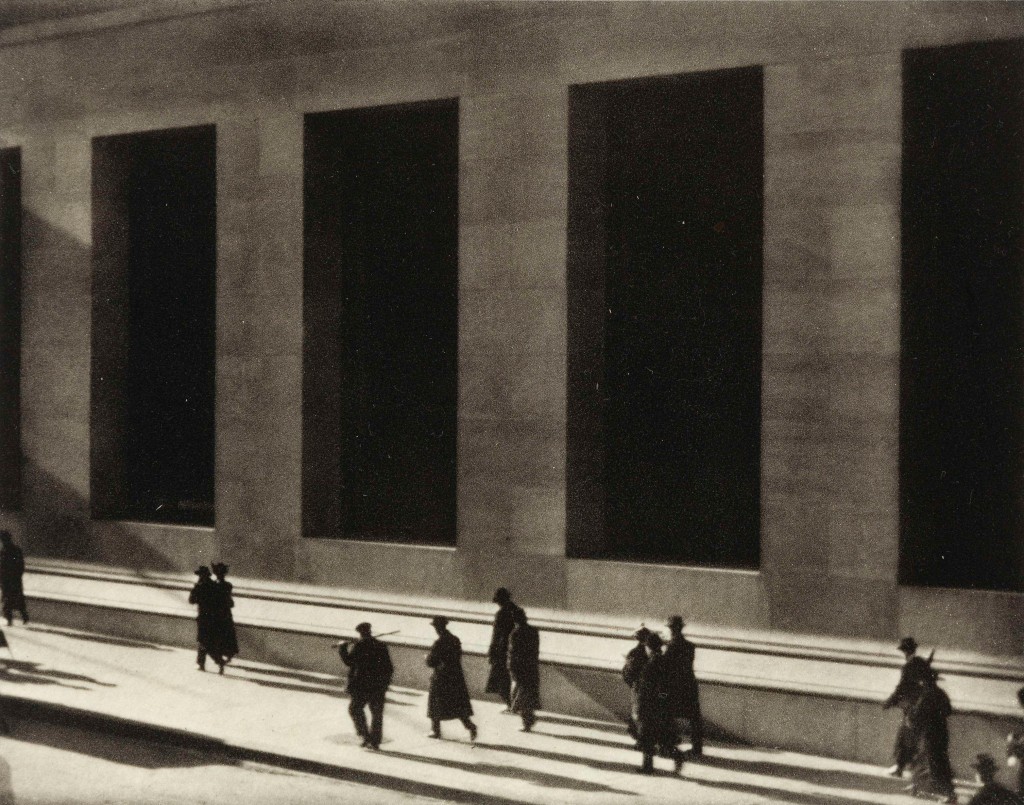
Paul Strand, Wall Street, 1915. This work is in the public domain in its country of origin and other countries and areas where the copyright term is the author's life plus 70 years or fewer.
Paul Strand — Wall Street, 1915 (Public Domain)

“Paul Strand’s 1915 photograph of Wall Street workers passing in front of the monolithic Morgan Trust Company can be seen as the quintessential representation of the uneasy relationship between early twentieth-century Americans and their new cities.” (Philadelphia Museum of Art, 1995:230).

Wall Street, 1915 is indeed a picture full of tension, simultaneously celebrating the accomplishments of the modern world while fearing what they might imply.

The photograph was one of six Strand images published by Alfred Stieglitz in Camera Work (Strand and Barberie, 2014:14) that launched his career as an artist and marked a departure from his earliest work in the Pictorialist style (Jeffrey, 2008:114). Leaving behind “his faltering attempts at fogbound, neo-romantic landscapes in the nineteen-tens” (Dickson, 2016), Strand embraced Modernism in scenes from urban life and experiments with abstraction, perhaps influenced by Cubism (Koetzle, H.-M., 2002:170). The influence of the picture was significant and it has been credited with doing “much to lead American photography toward sharp-focus realism as well as abstraction, toward urban subjects and the machine aesthetic” (Milton W. Brown, cited in Wall Street, New York, 1915, s.d.).

More than a century later Wall Street, 1915 can easily be recognised as portraying a daily commute, with people walking to or from their place of work while the sun is low in the early morning sky. It depicts an urban scene, with background architecture that is both modern and clearly American rather than European. The building that serves as a backdrop for the commuters appears very institutional and suggests the intimidating power of a bank, major corporation, or government.

The frame is heavy with geometry and leading lines—a deceptively simple image containing little or no detail in the shadows. The print is somewhat muddy, with deep shades of black but no true whites. This may have been a conscious choice on the part of the photographer, given that the highly-directional side lighting should have been capable of producing both deep shadows and brilliant highlights.

The figures in the scene are all walking in the same direction and there is a palpable sense of deliberate slowness. One man—few of the walkers appear to be female—has shouldered a cane or walking stick at an angle contrary to all the others in the frame, a lone working-class punctum whose presence among the better-dressed walkers might prick the attention of the careful viewer (see Barthes, 2010:27). The commuters are pacing themselves, perhaps in no particular rush to begin the work day.

If the commuters are in no hurry, the solid stone mass of the building behind them appears positively immovable. Where there should be windows, deep, shadowed rectangles suggest unseeing eyes or open graves—Strand himself later spoke of its “sinister windows—blind shapes” (Jeffrey, 2008:115). The imposing geometry of the structure dominates the street scene, its scale a display of power that dwarfs the organic shapes moving in front of it.

Oblivious to the dark heaviness beside and above them, the people walk casually into a rising sun with its early light full in their faces. The dawn connotes the promise of a new day and perhaps carries with it additional promises of knowledge and hope for the future. The glare in their eyes might not allow them a view of where they are going, but they may follow the orderly lines laid out for them on the pavement. The walkers can probably not see each other very well and, even though some travel in small clusters, this is largely a collection of individuals. They move in a common direction but they are not together.

The people are the only non-geometric, organic shapes, but they too are given a kind of geometry by their own shadows that distinguish them from the vertical lines of the monolith behind, long arms pointing backward and slowing their progress.

Wall Street, 1915 has all the dramatic feel of a movie set, looking much like a production still from a silent film backlot. The same idea may have occurred to Strand himself because, although he later claimed that he did not know how he had made the picture (Strand and Barberie, 2014:14), he returned to the location and reproduced a close facsimile of the scene in the 1921 film Manhatta (1921). Just a few years later director Fritz Lang’s Metropolis (1927) would offer a full-blown dystopian story of the evils of modern, mechanized city life, with great attention to the scale of buildings versus human figures—humans dominated by their own creations. Lang admitted that “the film was born from my first sight of the skyscrapers in New York in October 1924. […] I looked into the streets—the glaring lights and the tall buildings—and there I conceived Metropolis” (Minden and Bachmann, cited in Metropolis (1927 film) 2020).

But Wall Street, 1915 is not quite a dystopia. It is something more complex, managing to show “Strand’s willingness to accommodate documentary realism and abstraction within the same frame” (Paul Strand Artworks & Famous Photography, s.d.) and it is this tension that continues to give the photograph its power. The picture portrays an everyday scene of commuters heading to their place of work in an orderly, unhurried way leaving little trace of motion blur on the photographic plate. The walkers wear clothing that might be suitable for a cool spring or fall day, but they will enjoy a few moments to soak in whatever warmth may be had from the strong morning light.

If the reality conveyed by the image is common and reassuring, however, the abstraction is less so. The scene is crossed with graphic, sharp diagonals and inky rectangular pits that stay in the mind’s eye after the viewer has turned away—the kind of scene that Barthes might call subversive, “not when it frightens, repels, or even stigmatizes, but when it is pensive, when it thinks” (Barthes, 2010: 38). The daily commute is played out against a menacing backdrop that hints physically and visually at the power the rising city and its economy have over the workers. It would not be too many more years before the same dark windows were witness to the explosion of an anarchist bomb (1920) and the stock market crash (1929) that would ruin so many hopes.

Strand’s workers stroll forever, enjoying the benefits of living in the great city. If they are aware of any tension, their pace does not show it. But the signs are there.

References

Barthes, R. (2010) Camera Lucida: reflections on photography. (Paperback ed.) New York: Hill and Wang.

Dickson, A. (2016) ‘Paul Strand’s Sense of Things’ 15/04/2016 At: https://www.newyorker.com/culture/photo-booth/paul-strands-sense-of-things (Accessed 07/12/2019).

Hambourg, M. M. and Strand, P. (1998) Paul Strand, circa 1916. New York: The Metropolitan Museum of Art : Distributed by H.N. Abrams.

Jeffrey, I. (2008) How to read a photograph: lessons from master photographers. New York: Abrams.

Koetzle, H.-M. (2002) Photo icons: the story behind the pictures. Köln; London: Taschen.

Manhatta (1921) – Documentary Film by Paul Strand (s.d.) At: https://www.youtube.com/watch?v=qduvk4zu_hs (Accessed 11/01/2020).

Metropolis (1927 film) (2020) In: Wikipedia. At: https://en.wikipedia.org/w/index.php?title=Metropolis_(1927_film)&oldid=935508307 (Accessed 12/01/2020).

Mißelbeck, R. and Museum Ludwig (Köln) (2005) 20th century photography: Museum Ludwig Cologne. Köln [etc.: Taschen.

MoMA | Paul Strand, Charles Sheeler. Manhatta. 1921 (s.d.) At: https://www.moma.org/learn/moma_learning/paul-strand-charles-sheeler-manhatta-1921/ (Accessed 05/01/2020).

Paul Strand (s.d.) At: http://iphf.org/inductees/paul-strand/ (Accessed 07/12/2019).

Paul Strand | artnet (s.d.) At: http://www.artnet.com/artists/paul-strand/ (Accessed 07/12/2019).

Paul Strand Artworks & Famous Photography (s.d.) At: https://www.theartstory.org/artist/strand-paul/ (Accessed 05/01/2020).

Philadelphia Museum of Art (1997) Handbook of the collections. Philadelphia, Pa.: Philadelphia Museum of Art.

Philadelphia Museum of Art – Collections Object : Wall Street, New York (s.d.) At: https://www.philamuseum.org/collections/permanent/73744.html (Accessed 05/01/2020).

Selwyn-Holmes, A. (2010) Wall Street by Paul Strand. At: https://iconicphotos.wordpress.com/2010/12/13/wall-street-by-paul-strand/ (Accessed 05/01/2020).

Stieglitz, A. and Philippi, S. (2008) Camera Work: the complete photographs 1903 – 1917. Hong Kong: Taschen.

Strand, P. and Barberie, P. (2014) Paul Strand. (Second edition) New York, N.Y: Aperture.

Wall Street, New York, 1915 (s.d.) At: https://aperture.org/shop/paul-strand-wall-street-new-york-1915-photograph (Accessed 05/01/2020).

Visit—Àbadakone | Continuous Fire | Feu continuel

Àbadakone (Algonquin for “continuous fire”) is the second exhibition “in the National Gallery of Canada’s series of presentations of contemporary international Indigenous art, features works by more than 70 artists identifying with almost 40 Indigenous Nations, ethnicities and tribal affiliations from 16 countries, including Canada.”

According to the National Gallery, “the title Àbadakone was provided by the Elders Language Committee of Kitigan Zibi Anishinabeg. They felt that its connotation of a fire within each artist that continues to burn would be an appropriate title for the second presentation of this ongoing series of exhibitions showcasing Indigenous art from around the world.”

Indigenous art and culture is drawing a lot of attention in Canada and other countries dealing with the history and ongoing impacts of colonization of the “New World” by European powers.

I found the exhibit exciting as it opens up a broad range of discussions that are important not only for Indigenous people, but for anyone who has an interest in place, identity, the construction and evolution of culture, and the importance of narrative for creating and bearing meaning. The introduction at the entry to the exhibit indicates that the broad theme behind its curation is one of “Relatedness, Continuity and Activation.” In brief, this refers to the interconnection of all things, the links across time and generations, and “how an artist animates a space, an object, or an idea through performance, video or viewer engagement.”

(All images taken on my cellphone.)

For me, there were several threads that ran through the exhibit, particularly the challenges of:

  • colonization;
  • industrialization;
  • globalization;
  • environmental degradation;
  • technology;
  • migration; and
  • tradition.

Without taking anything away from the specific issues and questions facing the Indigenous artists who created these works, it seems to me that many of the challenges are also faced by non-Indigenous people. As a result of the challenges I’ve listed above, very few of us can simply take for granted the place where we stand, the identities we have inherited, the histories that have shaped us or the futures that lie before us. In a time of profound uncertainties, it will be important to draw selectively on our knowledge of the past, on our best understanding of our times and on the most promising paths forward. It is fascinating to see that while Postmodernism rejected meta-narratives, we continue to need overarching stories to interpret the past, create meaning in the present and have hope for the future.

Àbadakone has given me a number of ideas for the theme / concept I would like to explore for C&N A5 (“Making it up”), and perhaps even an approach for realising my ideas. I see Indigenous artists opening long-overdue conversations and I think we will all do well to participate in them honestly.

A3—Re-shoot

Following the comments I received from my tutor, I re-shot A3. I am submitting just the following image for this assignment as I feel that it portrays well what I wanted to say about how I feel.

The thought of dancing turns me white cold with fear

The eight images in the thumbnail below were taken during the re-shoot for A3. In the first three I am wearing a light jacket and boots so that I could test my set-up without being bothered too much by the cold. Once I knew it was working, I took a further five frames in quick succession—the temperature was -10C and I was wearing a cotton shirt and standing in snow with bare feet. I did not want to linger and, by this time, I knew what I was after.